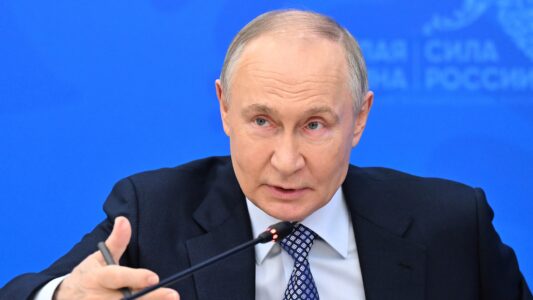

Russian President Vladimir Putin has rejected peace talks with Ukraine during a telephone conversation with US President Donald Trump, according to reports, as a Russian glide bomb attack on the Ukrainian city of Zaporizhzhia killed at least 20 people, including four children.
The deadly strike on Saturday morning targeted residential buildings in the southern Ukrainian city, with local officials saying that at least 32 people were injured. Several others were reported missing and believed to be trapped beneath the rubble.
Russian forces used five glide bombs in the attack, according to local authorities. Images and videos from the scene showed an apartment building largely destroyed after several floors collapsed.
Acting Mayor Regina Harchenko said more than 80 rescue workers were involved in search-and-rescue operations. Teams repeatedly paused their work to listen for signs of survivors trapped beneath the debris.
Harchenko described the attack as a strike at the city’s heart, expressing grief over the deaths of children and the suffering of their families.
Ukrainian President Volodymyr Zelensky condemned the bombardment, linking it to Trump’s announcement of a deal easing restrictions on Russian diesel imports. Zelensky described the move as a gift to Putin and argued that reducing pressure on Moscow could encourage further attacks.
In a social media statement, Zelensky said Russian strikes on Ukrainian energy facilities, including in Kyiv, demonstrated Moscow’s intentions.
“Russia’s choice is war,” he said, adding that Moscow would be prepared to end the conflict only when its ability to prolong it was diminishing.
Zelensky also said 13 other Ukrainian regions had come under attack overnight, arguing that Russia interpreted the easing of pressure as permission to continue its military campaign.
Zaporizhzhia, a major regional centre with a population of more than 700,000, lies less than 16 miles (26 kilometres) from the front line and has frequently faced Russian drone and missile attacks.
The latest bombardment comes amid an intensification of attacks on civilian and energy infrastructure as Russia’s full-scale invasion, launched in February 2022, continues.
On Thursday, at least 33 people were killed in a Russian glide bomb attack involving two civilian buses in Kramatorsk, in the eastern Donetsk region. A day earlier, a Russian missile strike on an apartment building in Pryluky, east of Kyiv, killed 22 people, including five children.
According to the United Nations, civilian casualties in Ukraine rose by 55 per cent during the first eight months of 2026.
Russia has also stepped up attacks on Ukraine’s energy infrastructure ahead of winter, a strategy Kyiv has repeatedly accused Moscow of using to put civilians under pressure. Russia denies deliberately targeting civilians.
Ukraine, meanwhile, has intensified strikes against infrastructure deep inside Russian territory, including oil refineries and terminals, saying the operations are intended to weaken Moscow’s ability to finance its war effort.
The latest developments underline the widening gap between diplomatic efforts to end the war and the continuing violence on the battlefield.