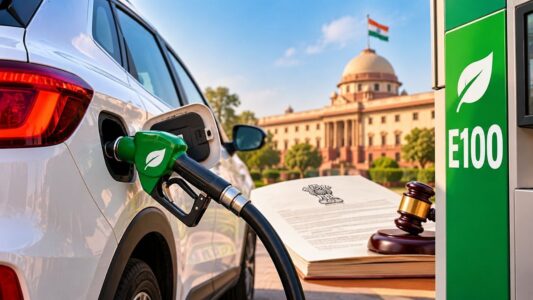

The Road Transport Ministry has amended the Central Motor Vehicles Rules to allow flex-fuel vehicles that run on up to E100, nearly pure ethanol, but only vehicles designed and certified for it can use the fuel. If you drive a regular petrol car, your fuel choices stay the same, and E100 is aimed at a new group of purpose-built vehicles such as the Wagon R Flex Fuel. The notification also lifts the weight limit for some light petrol and diesel vehicles in emission rules. Here is what the amendment does, what it means for buyers, and the questions it leaves open.
According to PTI, a senior ministry official said fuel beyond E20, up to E100, is meant only for vehicles designed and certified for it. Cars that run on E20 or normal petrol cannot use E85 or E100. The ministry has also changed certain vehicle classification thresholds, fuel specifications and technical references used in emission tables and testing rules.

What E100 and E85 Mean
E20 is petrol blended with 20% ethanol, and it is already on sale in India. E85 is 85% ethanol and 15% petrol, and E100 is close to pure ethanol. Flex-fuel vehicles are built to handle these higher blends, unlike conventional petrol cars, which are approved only for lower ethanol levels. Maruti Suzuki launched the Wagon R Flex Fuel in June, which can run on blends from E20 to E100.
The Weight Limit Change
For light petrol and diesel vehicles covered by these changes, the weight threshold has gone up from 3,000kg to 3,500kg.
Why the Government is Pushing Ethanol
The government has been promoting ethanol-blended petrol to cut dependence on imported crude oil, a major contributor to the current account deficit. With the West Asia conflict leaving many countries exposed to an energy crisis, flex-fuel vehicles carry more weight in policy. Toyota, Tata Motors and Hyundai are also developing flex-fuel vehicles for India.
What it Means for Car Buyers
- Do not experiment: If your car is not marked and certified as flex-fuel, do not fill E85 or E100. Check the fuel cap and owner’s manual if you are unsure.
- Expect more litres per km: Ethanol carries less energy per litre than petrol, so a flex-fuel car usually burns more litres to cover the same distance.
- Fuel availability matters: How useful a flex-fuel car is depends on how many pumps sell E85 and E100 near you. Ask a dealer before you buy.
Earlier Draft Changes
The ministry had earlier proposed draft changes to the Central Motor Vehicles Rules, 1989, covering E85 and E100, B100 biodiesel and hydrogen-CNG combinations. The notified changes cover flex-fuel vehicles that run on up to E100.
Source: PTI