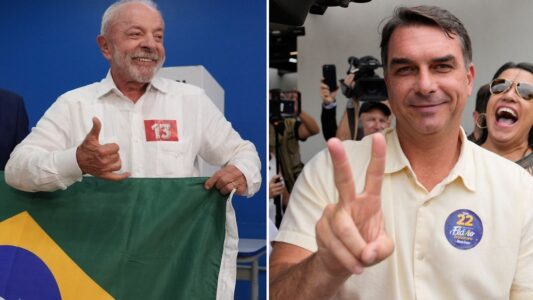

Brazil’s presidential election was thrown into uncertainty on Sunday as transport delays and bad weather disrupted voting, forcing polling stations to remain open for an additional two hours and raising the prospect of a contested result.
With nearly half of the votes counted, left-wing incumbent Luiz Inácio Lula da Silva held a narrow lead over his right-wing rival Jair Bolsonaro, winning 50.15% of the vote against Bolsonaro’s 49.85%.
The election also carries implications for US President Donald Trump’s ambitions in the region, with Lula having repeatedly challenged his policies, while Bolsonaro has aligned himself with Washington on issues including the use of lethal force against drug gangs.
Flávio Bolsonaro emerged ahead of Lula in the first round of voting earlier this month, but failed to secure enough votes to avoid a runoff. The margin was the narrowest in Brazil’s history, and most opinion polls suggest the two candidates are effectively tied.
Crime at Centre of Campaign
The fight against organised crime has emerged as one of the main issues for voters, amid concerns about the expansion of criminal networks and the impact of violence on communities.

Bolsonaro has made tackling drug gangs a central campaign promise, pledging to “declare war” on criminal organisations. He has also proposed building five new maximum-security prisons inspired by the model adopted by El Salvador’s President Nayib Bukele.
Lula, by contrast, has advocated targeting the finances and weapons of criminal groups, arguing that authorities must dismantle their leadership rather than focus on lower-level members. He has pointed to Brazil’s history of deadly police operations that kill suspected gang members but fail to capture the leaders of criminal networks.
Economy, Taxes and Household Debt
Economic pressures are another key concern, with many Brazilians struggling with rising food prices, household debt and a prolonged sense of economic stagnation. Under Lula, unemployment has fallen to record lows, while Brazil’s economy has remained largely insulated from US tariffs. However, rising living costs and mounting debt have weighed on the president’s approval ratings.
In an effort to address the problem, Lula recently expanded a debt-relief programme under which the government will purchase billions of dollars in delinquent consumer loans. Days before the election, he also banned online betting, which has contributed to concerns about Brazil’s personal debt crisis.
Bolsonaro, meanwhile, has drawn inspiration from Argentina’s President Javier Milei, adopting a pair of giant scissors as a symbol of his plans to shrink the state. He has promised $40bn in public spending cuts, alongside lower taxes and reduced red tape for businesses. His proposals are also aimed at workers increasingly turning to gig-economy jobs.
Democracy, Political Legacy and Corruption Claims
The election is also a contest over the political legacy of the Bolsonaro family and the future direction of Brazil’s democracy.
Lula, 80, has presented his candidacy as a defence of democratic institutions and an opportunity to prevent the return of the Bolsonaro family to power. He has also emphasised national sovereignty, having opposed Trump’s attempts last year to use tariffs and sanctions to help Jair Bolsonaro avoid prison.
The former president was convicted last year over charges of orchestrating a coup plot that included plans to assassinate Lula.
Flávio Bolsonaro, 45, has promised to restore his father’s conservative agenda while presenting himself as a more moderate figure in an effort to attract women and independent voters. He has sought to distance his campaign from the sexist, racist and homophobic rhetoric often associated with his father.
He has also pledged to seek amnesty for his father and for rioters jailed over the storming of Brazil’s centres of power after the previous election, an episode compared with the attack on the US Capitol.
Both candidates have accused the other of corruption.
Lula has highlighted an investigation into Bolsonaro involving millions of dollars raised for a biopic about his father from a disgraced banker at the centre of a billion-dollar fraud scandal. Bolsonaro has pointed to a past corruption case that led to Lula’s imprisonment, although the conviction was later set aside.
When Will the Results Be Announced?
Voting takes place on Sunday using electronic voting machines. Brazil’s electoral system is widely regarded by experts as one of the fastest and most secure in the world, and voting is compulsory. Turnout in the second round of the 2022 presidential election was close to 80%.
Brazil’s electoral authority is expected to begin releasing results after polls close at 4pm Eastern Time. A final tally will most likely be available a few hours later.