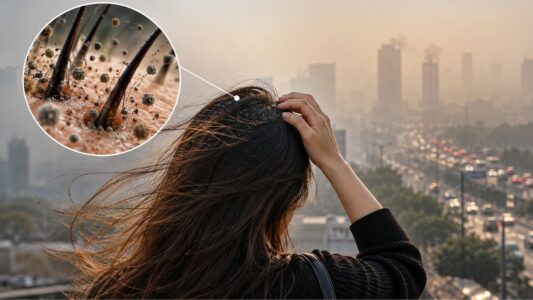

Most of us link dirty air to coughing, asthma and heart trouble. But scientists are finding that the same microscopic particles we breathe also settle on the scalp, and may be weakening the follicles beneath it.
The main culprit is particulate matter (PM), a mix of solid particles and droplets suspended in the air. PM10 refers to particles 10 micrometres or smaller; PM2.5 to those 2.5 micrometres or smaller, fine enough to slip into hair follicles. Outdoor air pollution kills an estimated 4.2 million people a year, according to the World Health Organization, yet its effects on skin and hair have received far less attention.
What the Lab Studies Show?
The first widely reported evidence came in October 2019, when Hyuk Chul Kwon of the Future Science Research Centre in South Korea presented findings at the 28th European Academy of Dermatology and Venereology (EADV) Congress in Madrid. His team exposed human follicle dermal papilla cells, which sit at the base of the follicle and direct hair growth, to PM10-like dust and diesel particulate for 24 hours.
The pollutants cut levels of β-catenin, a protein central to hair growth and follicle formation. Three other proteins involved in growth and retention (cyclin D1, cyclin E and CDK2) also fell, and the drop was dose-dependent: the more pollutant, the steeper the decline. Kwon said the work showed “how the most common air pollutants lead to hair loss.” Still, the centre is linked to a cosmetics company, and the experiment used cells in a dish, not people.
Other labs have filled in the mechanism. Researchers at Kyungpook National University applied PM to human scalp follicles cultured outside the body and found widespread death of follicular keratinocytes, driven by reactive oxygen species and inflammatory cytokines.
Also Read: “I Want To Kill Myself” As A Joke: How Casual Suicide Talk Online Could Hide A Mental Health Crisis
A 2020 Yonsei University study confirmed with electron microscopy that particles penetrate scalp tissue, where they trigger inflammatory signalling (NF-κB) and push follicle cells into premature ageing. A more recent Yonsei mouse study found PM2.5 exposure worsened postpartum hair loss, leaving fewer follicles and a smaller pool of hair follicle stem cells.
Human data also seems to be catching up. A large nationwide study in the British Journal of Dermatology, drawing on health-screening records from 2006 to 2022, found that every 10 μg/m³ rise in long-term PM2.5 exposure was tied to a 45% higher risk of alopecia areata, the autoimmune condition behind patchy hair loss (32% for PM10). For alopecia universalis, the most severe form, the PM2.5-linked risk more than doubled.
In China, an analysis of 95,535 hair-loss outpatient visits in the Sichuan Basin between 2017 and 2019 found that spikes in PM2.5, PM10 and nitrogen dioxide were followed by more clinic visits, with the particle effect peaking about five days later and stronger in cooler months. That study is a preprint still awaiting peer review.
The Verdict
Pollution is unlikely to be the main reason most people lose hair; genetics, hormones, stress and nutrition still dominate. Much of the evidence comes from cells and animals, and population studies show association, not proof of cause. But the signal is consistent enough to take seriously in smog-heavy cities. Washing hair after high-exposure days, covering it outdoors when air quality is poor, and eating an antioxidant-rich diet are sensible, low-cost steps. If shedding is sudden or patchy, see a dermatologist.