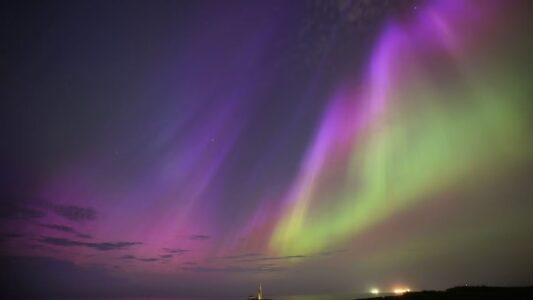

Skies across the United Kingdom were lit up by the northern lights on Friday and Saturday evenings. People spotted the glowing display from places far south of where it is normally seen, and the show may not be over yet.
Sky-watchers in Devon, Hampshire and Kent caught the aurora borealis, as the lights are also known. The Guardian in a report noted that the display is usually something people see near the Arctic Circle and in the north of Scotland, which makes sightings in southern England unusual.
More chances through Tuesday
The Met Office says people could keep seeing the lights until Tuesday, as long as the skies stay clear. Scotland and areas at a similar position relative to Earth’s magnetic field have the best odds.
What causes the lights
The aurora is a glowing show in the sky that starts with activity on the sun and with geomagnetic storms. The sun constantly throws off charged particles, known as solar wind, and they travel at around 1 million miles per hour.
When these particles meet Earth’s magnetic field, they get steered toward the magnetic poles. The Met Office says this happens most strongly when the solar wind’s polarity is opposite to the Earth’s. Once there, the particles crash into gases high in the atmosphere, and the collisions release energy as light.
The gas involved decides the color. Oxygen gives off green light, and at greater heights it can produce rare red displays. Nitrogen gives blue and purple shades.
A big year for aurora watchers
The timing fits a prediction. Experts said last year that 2026 would be a very good year for spotting the aurora, as the sun is in a period of heightened activity as part of its natural 11-year cycle.