
When India awoke to independence on 15 August 1947, not every part of the map turned saffron, white and green. Hundreds of princely states had to choose between India and Pakistan, and most fell into line quickly enough. One did not. Hyderabad, the largest, richest and most powerful princely state of all, sprawled across the Deccan in the very heart of the new nation, and its ruler had no intention of joining anyone at all.
Also Read: Who Is Mahant Swami Maharaj, The Spiritual Leader Of BAPS Amid The Eiffel Tower Controversy
A Muslim Ruler, A Hindu Majority
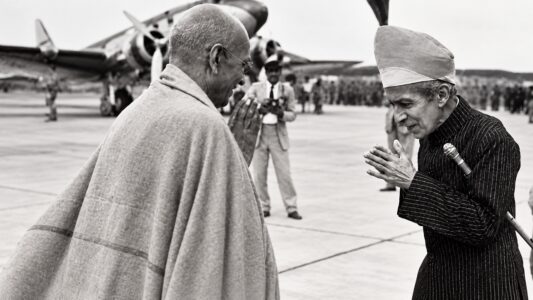
The Nizam, Mir Osman Ali Khan, was among the wealthiest men on earth, a Muslim monarch presiding over a population that was overwhelmingly Hindu. He dreamed of remaining a sovereign, independent state, and even sounded out Pakistan, Britain and the Portuguese in Goa in the hope of securing a route to the sea. In November 1947 he signed a Standstill Agreement with India, freezing the position for a year while negotiations went on. Beneath the surface of that pause, however, the ground was turning violent.

The Razakars and The Breaking Point
Much of the terror was the work of the Razakars, a private militia loyal to the hardline Majlis-e-Ittehad-ul-Muslimeen and its leader Qasim Razvi, who wanted Hyderabad kept out of India at any price. They attacked villages, minorities and even Muslims who favoured joining the Union, while a separate communist-led peasant uprising spread across Telangana. As order collapsed, India’s Home Minister Sardar Vallabhbhai Patel lost patience, famously describing Hyderabad as an ulcer in the belly of India that would have to be removed.

Five Days In September
On 13 September 1948, the Indian Army moved in under a mission code-named Operation Polo, described officially as a police action rather than a war. The Hyderabad forces and the Razakars, for all their numbers, were swiftly overwhelmed, and at five in the evening on 17 September the Nizam announced a ceasefire and surrendered. The Indian Army entered the city the following day, Razvi and the state’s prime minister were arrested, and the Nizam soon put his name to the Instrument of Accession. Hyderabad was, at last, part of India.

The Shadow Over The Victory
The integration came at a high and too often forgotten human cost. In the weeks after the surrender, large-scale communal violence swept the region, this time directed largely against Muslims, and a committee led by Pandit Sundarlal, appointed by Prime Minister Nehru, later estimated that tens of thousands of people had been killed. It is partly why the anniversary remains contested to this day, marked by some as Hyderabad Liberation Day and by others as a day of merger or integration, the chosen name depending very much on where a person stands. What is beyond dispute is the outcome itself. A kingdom that tried to remain a country of its own was folded into the Republic in barely a hundred hours, and the map of India settled into the shape we recognise today.