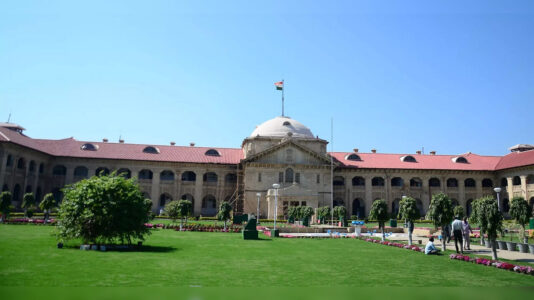

The Allahabad High Court, on Thursday, reserved its judgement on a habeas corpus petition by journalist Satyam Verma challenging his preventive detention under the National Security Act (NSA) in connection with his alleged role in the workers’ protest in Noida in April. Reserving its judgement in the case, the Allahabad High Court also orally questioned the use of the term ‘Aandolanjeevi’ in the grounds of detention forming the basis of the preventive detention order passed against journalist Verma under the NSA.
A division bench of justices Atul Sreedharan and Achal Sachdev reserved the verdict after hearing arguments from both sides.
Why Journalist Verma Challenged His Detention Under NSA
Journalist Verma has challenged his detention order dated May 12, passed by Gautam Buddh Nagar District Magistrate Medha Roopam, under Section 3(2) read with Section 3(3) of the NSA, as well as the subsequent approval granted by the Uttar Pradesh government.
The petition sought quashing of the detention order and consequential orders, besides Verma’s immediate release and compensation.
Detention Based on ‘Factually Impossible’ Premise, Says Journalist Verma’s Petition
The principal ground raised in the plea is that the detention order was based on a “factually impossible” premise that Verma was involved in violence in Noida on April 13.
According to the petition, CCTV footage and call detail records (CDRs) show that Verma was around 500 km away in Lucknow, where he was allegedly detained by Hasanganj police at 2:14 pm on the same day.
Journalist Was Not Named in Any FIRs, Says Verma’s Petition
The plea alleges that the investigating officer deliberately withheld the CDRs and CCTV footage from Hasanganj police station from the detaining authority, thereby vitiating the latter’s “subjective satisfaction”.
It also claims that Verma was not named in any of the 11 FIRs relied upon by the state for his detention.
The petition claimed the detention order was based on statements allegedly made by co-accused Mangal while in police custody.
Plea Disputes Characterisation of Verma’s Income By The State
The plea also disputed the state’s alleged characterisation of Verma’s professional income as “riot funding”, saying his earnings over nearly two decades were derived from his profession, received through formal banking channels and disclosed in income tax returns.
The plea alleges that the NSA was consequently used to “crush a spontaneous and lawful labour demand”.
It further alleges violation of Verma’s fundamental rights under Articles 19(1)(a), 19(1)(c), 21 and 22(5) of the Constitution, claiming that his political ideology, association with the Revolutionary Workers Party of India (RWPI), and profession as a translator and publisher of literature were sought to be criminalised.
Verma has also relied on an earlier Allahabad High Court order concerning co-detainee Akriti Chaudhary.
According to the plea, the court had quashed a similarly worded preventive detention order passed on the same date by the same authority and arising from the same agitation.
On this basis, Verma claimed that his case stands on an “even stronger footing” and sought quashing of the detention orders on the ground of parity.
After hearing the counsels for the parties, the court reserved its judgement.
With inputs from PTI