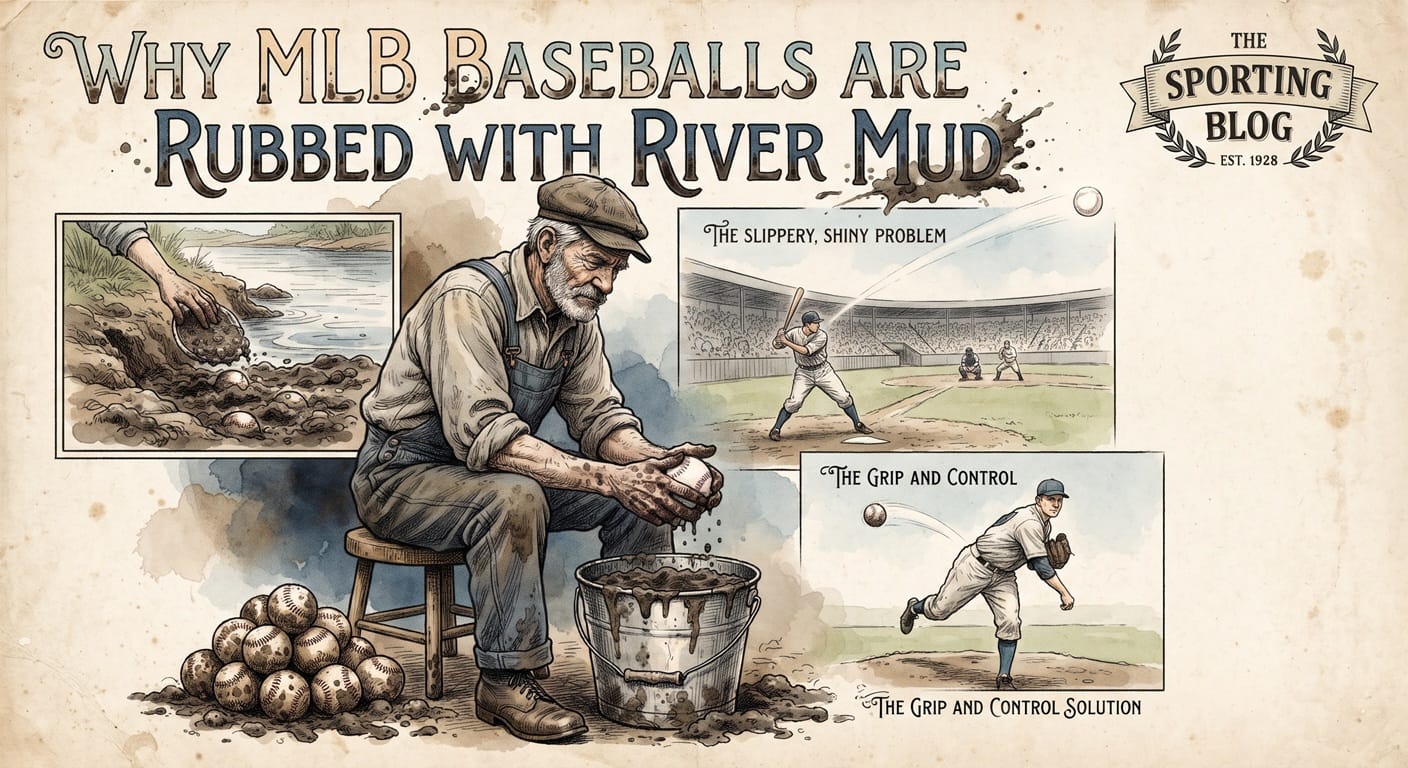
Every single baseball used in Major League Baseball is meticulously hand-rubbed with a secret river mud before every game to give pitchers an optimal grip.
Fresh out of the box, brand-new baseballs feature a slick, glossy factory finish that makes them nearly impossible for hurlers to grip securely at high velocities. Before this ritual was standardized, players resorted to chaotic remedies like tobacco juice, slippery elm, and shoe polish to rough up the leather.
Everything changed in the 1930s when a former coach named Lena Blackburne identified the ultimate geological solution along an undisclosed tidal location in the Delaware River estuary. This specific silt strikes a rare natural balance that no synthetic compound has ever managed to replicate.
It provides just enough abrasive friction to remove the slick factory sheen without degrading the delicate cowhide grain or softening the raised red seams. Clubhouse attendants prep roughly 120 balls before every single matchup using a precise, proprietary mix of this river mud and water.
The exact harvesting spot remains a closely guarded family secret, preserved through generations to maintain absolute consistency across the league.
Without this low-tech ritual, modern pitching mechanics would look entirely different, as hurlers would constantly struggle to control high-velocity fastballs and sweeping breaking balls. It stands as a brilliant reminder that even in a multi-billion-dollar sport driven by advanced analytics, baseball still fundamentally relies on a simple bucket of river silt.
| Leather Treatment Spec | Raw Factory Condition | Mud-Prepped Game Condition |
| Surface Texture | High gloss, slick finish | Matte finish with optimal tack |
| Grip & Control | Sub-optimal for high-velocity pitching | Enhanced friction for precise control |
| Hide Integrity | Sealed coating | Preserved full-grain cowhide |
Interested in more MLB trivia? Check out our MLB quiz: questions and answers for your friends, pub quiz, or just to test your knowledge.