
For 484 days in Hamas captivity in Gaza, former hostage Keith Siegel repeated events to himself so he would not forget them. He memorised the places where he was held, the dates on which he was moved and the attacks and humiliations he experienced or witnessed.
His aim was to preserve information that might help Israeli forces locate and free other hostages if he survived. He also wanted to keep track of time and eventually tell his family what had happened to him.
Now back home, he says the memories remain with him. “I’m living a kind of dual life,” he said in an interview to The Guardian in Tel Aviv. “I’m here for some of the time, and I’m in Gaza some of time. It’s very challenging to convey in words what it was like.”
Siegel and his wife, Aviva, were abducted from their home in Kibbutz Kfar Aza in southern Israel during the Hamas-led attacks of 7 October 2023.
They were among 251 people taken hostage that day, when Hamas militants crossed the border and attacked kibbutzim, towns, military bases and a music festival.
Israeli security forces were caught by surprise. By the time the area had been brought back under Israeli control, 1,209 people had been killed, the majority civilians, including 36 children, according to records kept by the Israeli newspaper Haaretz.
Nir Oz Remembers
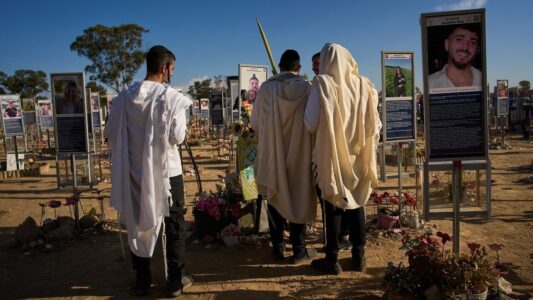
At nearby Kibbutz Nir Oz, two lines of fresh graves mark the lives lost on the same day. One shared plot contains the graves of a family of five – a mother, father and their three young children. A garden has been created around the graves, with space left for their grandparents, who survived.
Shlomo Margalit, who will soon turn 89, tends the cemetery. He points to the graves of three of his oldest friends, who helped found the kibbutz after moving there from Haifa in the 1950s. “This is my life project, as well as my home,” Margalit said.

He survived the Hamas attack in his safe room with his wife, Hanna. He has since returned to Nir Oz and is temporarily living in the former home of Gadi Moses, who survived 482 days in captivity. For Margalit, preserving the memory of those killed is part of rebuilding the community.
A five-person volunteer defence force held Hamas fighters at bay for at least two hours, he said. After all five were shot, Hamas forces took control of the kibbutz.
Homes were burned, families were killed and people were abducted.
Margalit said Hamas fighters, other Palestinian gunmen and civilian looters had left before the first Israeli soldier arrived.
Nir Oz, he said, had been forgotten by the army and was left without military protection. In total, 47 people from the kibbutz were killed and 76 were taken hostage. They included Shiri Bibas and her sons, 10-month-old Kfir and four-year-old Ariel, who were later killed in Gaza.
The dead and hostages accounted for more than a quarter of the small community.
Revisiting the events remains painful for Margalit, but he continues to speak publicly about them. “I want people to know what really happened here,” he said.
‘The Trauma is Always There’
The Siegels, who lived in Kfar Aza, have decided not to return. They are instead concentrating on their mental and physical recovery.
Aviva was 62 when she was abducted and Keith was 64. “What happened to me in Gaza, what happened with Keith in Gaza, it’s there all the time,” Aviva said. “I understand that it’s going to be a process of healing. There’s always things that remind me, and if I don’t remember, then he reminds me. If I’m cooking lunch or making a cup of tea and I turn around and see Keith with tears in his eyes, because he just read something or let himself feel.”
The approaching anniversary has made the experience particularly difficult.
Last year, Aviva was still campaigning for the release of other hostages and said the urgency of that effort left little room for her own emotions.
For a period, she tried to cope by repeatedly telling herself: “I must feel lucky,” because she had survived.
Now, she says, she has begun allowing herself to process what happened. “Getting ready [for the anniversary] has been very very painful,” she said. “The last couple of weeks all I want to do is cry. Now I’m feeling things I didn’t feel before.” “When I hear my grandson say he is afraid of being kidnapped in the middle of the night, it breaks my heart.”
Aviva has written a book, Survived to Tell, about her experience. She describes writing it as both therapy and a celebration of survival. She said she wanted her grandchildren to know what she and Keith had endured, to tell the stories of other hostages who could not tell their own stories and to reach readers in Israel and elsewhere.
Questions Over Israel’s Response
The third anniversary of the attacks comes weeks before national elections, with debate intensifying over who should be held responsible for the failures of 7 October and how the war that followed has been conducted.
Survivors and bereaved relatives have largely remained outside the political debate as they continue to deal with trauma and rebuild their lives.
Israeli Prime Minister Benjamin Netanyahu has strongly opposed an independent state commission of inquiry. Critics argue that he fears such an investigation could expose his own failings. In the immediate aftermath of the attacks, there was widespread speculation that Netanyahu would not remain in office. Israel’s coalition governments have rarely completed their full terms.
Netanyahu had for years promoted a security policy based on the belief that Hamas was “contained” in Gaza, behind layers of fortifications.
The security officials who were in command on 7 October have since stepped down. Netanyahu, however, remains in power and has resisted calls for his resignation.
Both Israeli and US officials have said Netanyahu rejected ceasefire proposals that could have ended the war and secured the release of more Israeli hostages sooner.
Netanyahu is also facing a corruption trial and has pushed for the continuation of Israeli military operations in Gaza, while coalition partners have called for ethnic cleansing and annexation of Palestinian territory.
The war launched by Israel after the 7 October attacks has killed more than 74,000 Palestinians, the majority civilians, including about 20,000 children.