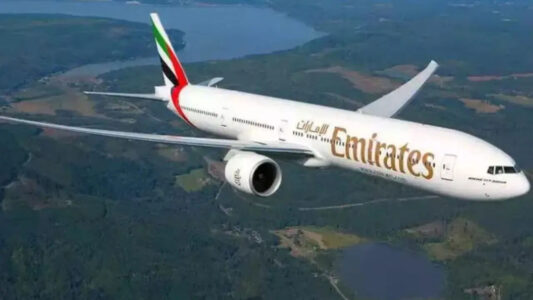

Emirates Group reported a sharp fall in its financial performance for the first half of the 2026-27 financial year, with profit before tax declining 66 per cent to AED 4.1 billion ($1.1 billion). The Dubai-based aviation major faced mounting pressure from geopolitical tensions, flight disruptions and a steep rise in fuel prices, which affected its airline and ground-handling operations.
The Group’s revenue dropped 12 per cent year-on-year to AED 66.2 billion ($18 billion) during the six months ended September 30, compared with AED 75.4 billion in the same period a year ago. Earnings before interest, taxes, depreciation and amortisation (EBITDA) also contracted 41 per cent to AED 12.5 billion.
Despite the challenging operating environment, the company managed to sustain customer demand and maintain healthy cash levels, supported partly by its cargo business.
Emirates Group H1 Results: Revenue, Profit Decline
Emirates Group Chairman and Chief Executive Sheikh Ahmed bin Saeed Al Maktoum said passenger demand continued to remain resilient during the reporting period. He also highlighted the contribution of cargo operations in supporting the Group’s revenue and liquidity position, even as international jet fuel prices doubled compared with the year-ago period.
Sheikh Ahmed acknowledged the UAE government’s role in managing the situation and facilitating the restoration of air transport services following military developments across the Gulf region.
The airline’s standalone financial performance also reflected the impact of the disruptions. Emirates recorded a 68 per cent decline in profit before tax to AED 3.7 billion, while revenue fell 13 per cent to AED 56.9 billion.
Passenger traffic was significantly affected, with the airline transporting 21.8 million passengers in the first half, marking a 22 per cent year-on-year decline. Intermittent restrictions on airspace and fewer scheduled flights affected its ability to operate at normal capacity.
Emirates Restores 91% Of Pre-Disruption Flight Network
Despite the operational challenges, the airline made progress in rebuilding its international network. By the end of September, Emirates had brought back 91 per cent of its pre-disruption network, serving 150 airports across 78 countries and territories.
Its cargo division emerged as an important contributor during the period. Emirates SkyCargo recorded a 52 per cent increase in revenue, even though cargo volumes edged down 1 per cent to 1.2 million tonnes.
The regional conflict reduced the availability of airfreight capacity in certain markets. At the same time, disruptions to maritime transportation encouraged several shippers to explore air cargo services as an alternative for moving goods.
The performance highlighted the importance of cargo operations in supporting the airline’s financial position at a time when passenger services were facing considerable headwinds.
Higher fuel prices remained among the biggest challenges for Emirates during the six-month period. The airline’s fuel expenditure, before accounting for hedging gains, increased 60 per cent.
However, its fuel price risk management strategy provided some relief. Gains of AED 7.1 billion from the strategy helped restrict the overall increase in net fuel costs to 13 per cent, cushioning part of the impact of the surge in global oil prices.
The Group’s ground-handling and aviation services subsidiary, dnata, also reported weaker financial results for the first half.
Its profit before tax declined 51 per cent to AED 410 million, while revenue decreased 7 per cent to AED 11 billion. The fall was attributed to lower business volumes across certain operations in the UAE and the UK.
Looking ahead, Sheikh Ahmed said the Group would continue monitoring expenses and geopolitical developments while maintaining its investment plans. These include expanding its fleet, improving customer products and strengthening operational capabilities.
Despite the challenging six-month period, Emirates Group retained a sizeable liquidity buffer. Its cash reserves stood at AED 54.1 billion as of September 30, compared with AED 59.6 billion at the end of March 2026.