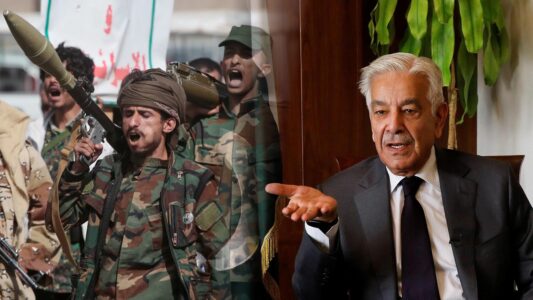

Pakistan Defence Minister Khawaja Asif has said Islamabad is ready to fulfil its obligations under the Makkah Joint Defence Agreement after Saudi Arabia reported an attempted Houthi drone attack near the Muslim holy city of Mecca. Speaking to Geo News on Wednesday, Asif said the agreement “applies to us” and that Pakistan would fulfil its duty.
He added that Pakistan did not need a formal agreement to protect the holy sites, describing their protection as a responsibility in its own right. The comments came after Saudi authorities said their air defences intercepted and destroyed a Houthi drone south of Mecca. According to the Saudi account, the drone was brought down before it entered the prohibited airspace around the holy city.
The Houthis, however, denied that they had targeted Mecca or any Islamic holy site. The incident comes amid a broader escalation involving Saudi Arabia and the Iran-backed group, including attacks on Saudi territory and threats affecting maritime traffic around the Red Sea.
What Is The Makkah Joint Defence Agreement?
Pakistan, Saudi Arabia and Türkiye signed the Makkah Joint Defence Agreement in the Saudi city on August 7. The agreement is designed to strengthen collective deterrence and expand defence cooperation among the three countries.
Its central provision states that an armed attack against any one of the three signatories will be regarded as an attack against all three. The agreement also provides for enhanced cooperation across defence-related areas.
Asif said the pact applies when the territorial integrity or geographical boundaries of any of the three countries are violated. He also stressed that there was “absolutely no ambiguity” about its application, while declining to publicly discuss Pakistan’s defence or military strategy.
The agreement was signed by Saudi Crown Prince and Prime Minister Mohammed bin Salman, Turkish President Recep Tayyip Erdoğan and Pakistani Prime Minister Shehbaz Sharif at the Makkah Al-Mukarramah Summit for Joint Defence.
The pact is officially described by Pakistan as defensive in nature and intended to strengthen collective deterrence against external aggression. Pakistan’s Foreign Ministry has also said the agreement is not directed against any particular country.
Asif Sends Message To Iran
Asif also said Pakistan had conveyed Saudi Arabia’s message to Iran amid concerns over Houthi attacks against the kingdom. He said he did not expect Iran, as a state, to open another front while already involved in a wider regional conflict.
The Pakistani defence minister distinguished between Iran as a state and non-state groups operating in the region. He said such groups could potentially act without waiting for formal approval or support from a government.
Asif said it would not be prudent for Iran to become directly involved in the conflict between the Houthis and Saudi Arabia. He added that Pakistan would continue efforts to prevent the conflict from spreading into additional theatres.
Pakistan’s position comes as the Makkah agreement moves beyond the signing stage. The inaugural meeting of the Strategic Political and Defence Committee established under the pact was scheduled to bring together the foreign and defence ministers and military chiefs of the three countries in Istanbul.