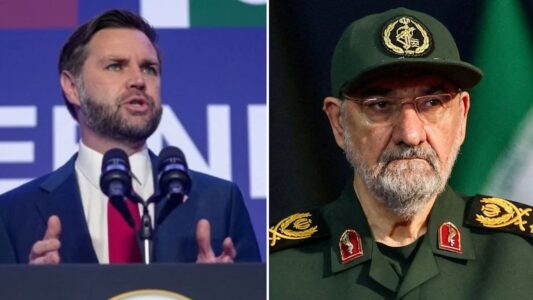

US Vice-President JD Vance has opened a direct channel to one of Iran’s most influential hardliners in an attempt to revive peace negotiations, according to a report by The Wall Street Journal, even as President Donald Trump threatens to resume military strikes in the coming weeks.
Vance sent a letter to Mohsen Rezaei, secretary of Iran’s Supreme National Security Council and a former commander of the Islamic Revolutionary Guard Corps (IRGC), to test whether Washington and Tehran could agree on a framework for negotiations, the report said.
The letter was sent at Trump’s direction, according to a person familiar with the matter cited by the newspaper, and the president was aware of the initiative.
Trump, however, denied instructing Vance to initiate peace talks with Iran, saying the vice-president’s contact concerned medical supplies. “Iran needs help with medical supplies. Basically, it’s getting supplies in to help people that are not well,” Trump told reporters at Joint Base Andrews when asked whether he had directed Vance to begin negotiations.
The outreach is aimed at determining whether diplomacy can prevent another round of fighting. However, discussions have yet to produce a detailed peace proposal.
Rezaei said last week that Iran would not negotiate with Washington until its core demands were met.
Q: Did you direct Vance to talk to Iran to start peace negotiations?Trump: No. Iran needs help with medical supplies. Basically, it’s getting supplies in to help people that are not well. https://t.co/8AZ8Jg84Kr
— Clash Report (@clashreport) October 28, 2026
Vance Seeks Diplomatic Opening
The outreach places Vance at the centre of a delicate effort to find a diplomatic way out of the conflict, which began with the launch of the US military operation “Epic Fury” in February.
Although Vance has publicly backed the war, he has privately expressed reservations about prolonging it. Before Trump launched the operation, the vice-president had argued for more robust diplomatic efforts.
Trump later appointed Vance as lead negotiator, and the vice-president travelled abroad twice to meet Iranian counterparts in pursuit of an agreement to end the conflict.
A memorandum of understanding reached in June collapsed just two weeks after it was signed, following disagreements over how shipping through the Strait of Hormuz would be restored.
Subsequent negotiations, mediated by Qatar and Pakistan, have failed to break the deadlock. Washington wants Iran to make concessions on its nuclear programme upfront, while Tehran is demanding immediate economic relief.
Rezaei’s emergence as a potential interlocutor could reshape the diplomatic process, possibly sidelining figures such as Iranian Foreign Minister Abbas Araghchi and parliament speaker Mohammad Bagher Ghalibaf.
A veteran of Iran’s 1980s war with Iraq, Rezaei led the IRGC for years and has become an influential voice as the threat of renewed US attacks grows.
Earlier this month, he warned that Iran could target the United Arab Emirates, as well as data centres and internet cables across the region.
On Sunday, he met security chiefs from Saudi Arabia, Pakistan and Turkey in Tehran in a rare high-level engagement, as regional powers sought to contain the conflict.
Trump Alternates Between Diplomacy and Threats
Trump has repeatedly shifted between pursuing a diplomatic settlement and threatening to intensify military action against Iran. Dismantling the country’s nuclear programme remains a central national-security priority of his second term.
Last week, Trump said Washington was not negotiating with Tehran and suggested military action was imminent. During a campaign stop on Tuesday, he accused Iran of dragging out efforts to reach a deal and warned that waiting until after the election would not help Tehran.
The conflict also carries domestic political risks for the Republican Party ahead of the midterm elections. Republicans face the prospect of losing seats in both the House of Representatives and the Senate, while voters have cited the war and rising fuel prices among their concerns.
Vance, an early contender for the 2028 Republican presidential nomination, is therefore navigating both foreign-policy and domestic political pressures.
Trump has said the war will end only when he decides it should. Whether Vance’s reported backchannel can produce a viable diplomatic path before the president orders another attack remains uncertain.