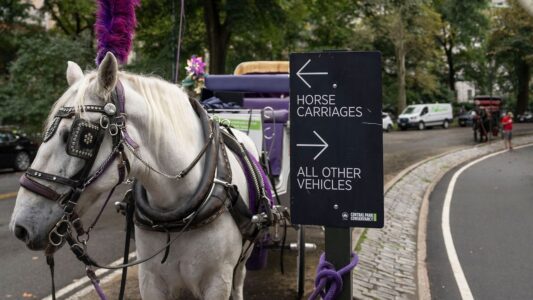

Horse-drawn carriages will be banned in New York City after the City Council approved a new bill Thursday that will end a Central Park tradition that’s lasted for more than 150 years. The campaign gained momentum after the death of an 18-year-old Indian tourist.
Romanch Mahajan died in June after a horse pulling a carriage carrying him and his family bolted in Central Park. The carriage driver had stepped away to take their photograph when the incident occurred. Mahajan’s mother fell from the carriage as the horse bolted. He fell while trying to help her and struck his head on the ground.
His death prompted his parents to campaign for an end to the carriage industry, making an emotional appeal to New York City Council members via videoconference from their home in India.
Several members of the family attended the Council proceedings on Thursday, when lawmakers voted to approve legislation banning horse-drawn carriages in the city. Mahajan’s family has also taken steps to file a wrongful-death lawsuit against the city and utility company Con Edison, alleging that stray voltage caused the horse to become agitated.
The legislation will prohibit horse-drawn carriages from operating in New York City from June 2028, giving officials nearly two years to work out the details of the transition.

Mayor Zohran Mamdani has said he supports the initiative but has not confirmed whether he will sign the bill. The legislation is also expected to face a legal challenge.
Transport Workers Union Local 100, which represents carriage owners, has threatened to challenge the measure in court. In a letter to city officials on Wednesday, the union’s lawyers said legal action would follow if the Council passed the bill.
Opponents argue that the horses are well cared for and subject to strict regulations. They also say the proposed arrangements for workers affected by the ban are insufficient.
The legislation calls for a “horse-drawn-cab-industry transition plan” to be developed by next April. However, it provides few concrete details on how the city will address the financial impact on roughly 200 owners, drivers and stablehands whose livelihoods depend on the industry.
Questions also remain over the future of the approximately 180 carriage horses.
Supporters of the ban say the period before it takes effect will give officials time to resolve these issues. The union, however, has dismissed the proposed transition arrangements as inadequate.
The Council’s decision has also drawn criticism from President Donald Trump, a New York native who expressed his disapproval in a social media post on Thursday.
“The Horse-drawn Carriage in New York City is a quintessential New York experience,” he wrote. “So sad that, for political reasons, we will see it go!”
Those opposing the ban have argued that other forms of transport in and around Central Park, including speeding cyclists, e-bikes and pedicabs, pose greater risks.
Since Mahajan’s death in June, a cyclist has died after colliding with an unleashed dog, while a pedestrian was killed after being struck by a cyclist.