
The streets of France have become a rather unexpected mix of political demonstrations, anime references, horror masks, inflatable costumes and scenes of destruction. What began as high school students protesting poor educational conditions has grown into a wider movement against rising living costs and deteriorating public services, with the demonstrations also drawing trade unions and other sections of society.
From School Blockades To Street Protests
The current student movement began in the Paris region in mid-September 2026, with high school students raising concerns about overcrowded classrooms, teacher shortages and deteriorating school infrastructure. Reports of broken facilities, including toilets, and concerns about the condition of school buildings have featured prominently in students’ complaints.
The demonstrations subsequently spread to other parts of the country, bringing high school and university students together. Concerns about police violence and the future facing young people also became part of the movement. By October 17, the protests had merged with broader demonstrations against the cost of living, fuel prices and the state of public services.

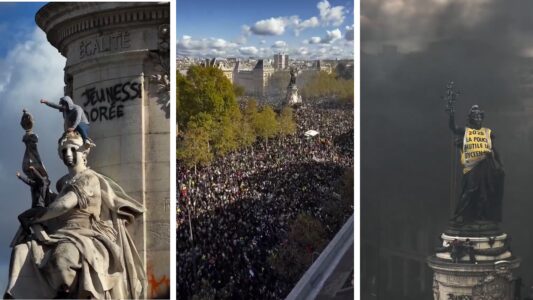
The scale was significant. France’s Interior Ministry put the turnout on October 17 at around 550,000 people across 110 marches, while organisers estimated approximately 800,000. Most people demonstrated peacefully, but violence in several cities overshadowed the day’s wider demands.
One Piece, Horror Masks And The Art Of Protesting Differently
If conventional protests are associated with banners, slogans and speeches, French students have added an unmistakably internet-native twist. At demonstrations in Paris, young protesters have been spotted wearing masks representing characters such as Batman, Chucky, Jigsaw and the Gremlin. One student turned up in a nearly two-metre-tall inflatable frog costume, while others wore the straw hat associated with Monkey D. Luffy, the protagonist of the Japanese manga and anime series One Piece.
The appeal is not simply about dressing up for a viral photograph. For a generation raised on anime, gaming, memes and social media, these references offer a common language that can bring together people who might otherwise have little in common.

One student interviewed by Le Monde explained that wearing Luffy’s hat was a tribute to protesters in Nepal and Madagascar, where the character’s imagery had appeared in earlier youth-led demonstrations. The pirate’s association with freedom and resistance has made the symbol particularly adaptable to different political causes.
The pink Panther costume reportedly spotted amid the French demonstrations fits this broader visual trend. However, without a verified report establishing who wore it and what the person was doing, the costume should be treated as a viral visual rather than evidence of a specific protest action.
When Protest Footage Turns Into A Viral Spectacle
The costumes are only one part of the story. Social media has also circulated footage and claims about people taking advantage of the disorder to loot shops, turning the demonstrations into a stream of bizarre and disturbing viral moments. Luxury retailers were among the targets. In Bordeaux, stores including Louis Vuitton and Apple were looted, while a Hermès boutique and a Rolex store were targeted in Marseille, according to reports. Businesses across several cities were vandalised, with masked groups breaking into premises as clashes spread.
🚨🇫🇷💄 “OH NOM DE DIEU, J’AI PRIS TOUT ÇA POUR TOI, BÉBÉ !”Un individu a PILLÉ UN MAGASIN DE COSMÉTIQUES pour offrir son butin à sa petite amie, lors de la mobilisation du 17 octobre. https://t.co/f6MYHPRk5k
— Impact (@ImpactMediaFR) October 17, 2026
Online accounts have also shared claims about a man allegedly taking cosmetics from a looted store for his girlfriend, as well as footage said to show a person dressed as Spider-Man handing out sanitary pads reportedly taken from a supermarket. These anecdotes fit the internet’s appetite for surreal moments during public disorder, but their details and context have not been independently established in the reporting available for this story.
There is an important distinction here: the people participating in peaceful demonstrations should not automatically be equated with those committing theft or vandalism. French authorities have attributed much of the violence to groups and individuals involved in looting and attacks, while the wider demonstrations included hundreds of thousands of people protesting economic and public-service concerns.
The Destruction Behind The Viral Clips
Away from the costumes and viral clips, the damage has been serious. In Limoges, a fire engulfed the historic town hall, an 1883 building, after masked individuals broke into the premises and started a blaze. The fire severely damaged the structure, with parts of the roof and tower affected. Reports describing the building as having completely collapsed should therefore be treated cautiously: the confirmed account is of extensive fire damage and the loss of much of the historic building.
In Lyon, the tourist office was set on fire, while municipal buildings and businesses were targeted in other cities. French Prime Minister Sébastien Lecornu announced around 1,200 arrests and 150 injured police officers and gendarmes following the October 17 unrest.

The scale of the destruction has complicated the movement’s message. Students began by demanding better schools and more support for public education; the wider mobilisation then brought in concerns about prices, wages and public services. Looting and arson have since become a competing story, threatening to eclipse those original grievances.
Why Does Gen Z Protest This Way?
For young demonstrators, humour and pop culture can make a protest feel less formal and more accessible. A recognisable character or an absurd costume can attract attention, provide a shared identity and make footage instantly recognisable online. As historian Véronique Servat told Le Monde, these cultural references can bring together young people who would not ordinarily mix, while giving demonstrations a sense of collective energy.
That does not mean every costume carries a political message, or that every viral moment represents the movement as a whole. The same online environment that amplifies creative forms of protest can also turn looting and destruction into spectacle, making it harder to distinguish political participation from opportunistic criminal behaviour.

The trend also connects with youth movements elsewhere. One Piece imagery has appeared in demonstrations in Nepal and India, while other Gen Z-led movements have used internet culture to communicate dissatisfaction with governments and institutions. The Palestinian flag has also featured in different protest settings internationally, but the reported display at Italy’s Leaning Tower of Pisa should not be presented as part of the French demonstrations without evidence connecting the incidents.
France’s student protests are therefore about more than anime costumes or strange viral clips. They reveal a generation using familiar cultural symbols to make itself visible, while raising serious questions about education, inequality and the cost of living. The costumes might make people stop scrolling. The school conditions, economic anxieties and questions about public accountability are what brought many demonstrators onto the streets in the first place.