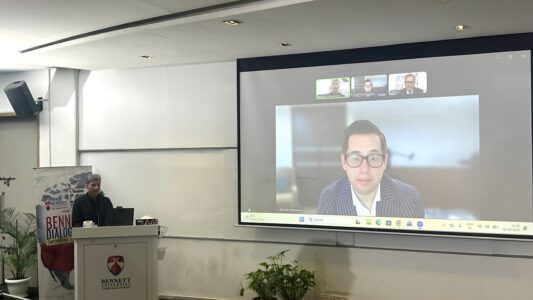

In February 2023, a year after Russia’s full-scale invasion of Ukraine, a Texan IT executive flew into Moscow for what he planned as a fact-finding visit. He gave the city twenty-four hours. By the end of them, he had made up his mind, and that September he returned with his wife and children, having sold almost everything they owned in the United States. Jozef Schutzman, a former senior hand at Microsoft, Oracle and Red Hat, now lives on the outskirts of the Russian capital, co-hosts the show Russia Up Close with fellow American Eddie Gonzales, and has become one of the most recognisable Western voices defending Moscow’s view of the war. On 16 October, he brought that view to Bennett University in Greater Noida, in conversation with Times Now Managing Editor Zakka Jacob for a session of Bennett Dialogues titled “Unpacking the Russia-Ukraine Conflict and Western Media Narrative on It”.
A Country That Thinks In Binaries
Schutzman began with an observation about his own countrymen rather than about Russia. A European acquaintance, he recalled, once told him that Americans are unusual in seeing the world in strictly binary terms, good guy or bad guy, cowboy or Indian, with nothing in between. That habit, he argued, explains how most Western audiences understand the war, with Vladimir Putin cast as the villain and Volodymyr Zelenskyy as the hero, and little attempt to grasp where either side is coming from.
He was candid about the limits of his own vantage point. He speaks little Russian, he acknowledged, so most of the Russians he talks to are English speakers, a group he described as more centrist and Western-leaning than the country at large. Even among them, he said, he finds people critical of the government who nonetheless support the war. Russians are tired after four years of fighting, he told the audience, but war-weariness has not turned into opposition.
The Case He Makes For Moscow
At the heart of Schutzman’s argument was a familiar thesis about NATO. Without America, he contended, the alliance would not exist, and Ukraine was meant to remain a neutral buffer between two great powers. In his telling, the West crept steadily eastward for decades, the 2014 Maidan revolution marked a breaking point, and Russia showed restraint for longer than any superpower would. He invited the audience to imagine Washington’s response if Canada or Mexico aligned with a hostile power on its border, and suggested the United States would not tolerate it for a day. The conflict, he concluded, was always going to happen, and the West engineered it gradually enough to avoid the blame.
He went further on Western motives, arguing that Ukraine’s mineral and agricultural wealth is part of what is at stake, and that much of the Russian public sees its soldiers as fighting the West rather than Ukraine itself. He also offered a stark warning. Those hoping for Putin’s departure, he suggested, should be careful what they wish for, because a successor elected before the war ends might be pushed by years of accumulated public anger towards something harsher.
Those claims sit squarely within the Kremlin’s own account of the war. Ukraine, its European allies and most Western governments reject them, maintaining that Russia launched an unprovoked invasion of a sovereign state and that Ukraine’s choices of alliance are its own to make.
Life In A City Reported To Be On Fire
Some of Schutzman’s most vivid moments came from daily life. Friends and family in America, he said, still ring him in alarm whenever Western headlines suggest that Moscow is burning after a drone strike. He lives so far out in the suburbs, he joked, that the whole city could be ablaze without his noticing. Russian air defences bring down drones by the hundreds, he said, and his chances of dying in a road accident are greater than of being hit by one. He described Moscow as the safest city he has ever lived in, though his own mother, he admitted, remains too frightened to visit.
On free speech, he recounted an exchange with a CNN correspondent who asked him whether he felt constrained in Russia. His answer was that no country allows unlimited speech, only different boundaries. In America, he argued, the penalties are social rather than legal, and had he voiced his current views while living there, he believes he would have been blacklisted from corporate employment for good. He conceded that he has not tested Russia’s limits, saying he largely agrees with the government’s positions. Rights groups point out that Russian law now punishes public criticism of the armed forces with heavy prison terms, and that the country ranks near the bottom of global press freedom indices.
Trump, India and a Generation Divided
Schutzman reserved some of his sharpest criticism for Donald Trump, whom he accused of hypocrisy, of breaking his promise to be a president of no new wars, and of condemning Moscow while Washington continues to supply Ukraine with weapons and intelligence. Turning to India, he spoke sympathetically of a country caught between pressure from Washington over Russian oil, tensions with China and its own rise as a manufacturing power, and suggested New Delhi has had to find its own path between them.
As the conversation turned to young people, he described a sharp divide among Russia’s youth. Some, he said, are liberal and drawn to the West, while many more are traditional and intensely patriotic. Like much of the world, he observed, Russia is governed by an older generation increasingly out of touch with the young. He closed on communism, quoting Putin’s well-known line that anyone who does not miss the Soviet Union has no heart, while anyone who wants it back has no brain.
Why The Conversation Matters
Few Indians will ever hear the war described from inside Russia by someone who grew up on the American side of it, and Bennett Dialogues gave its audience precisely that. Schutzman is open about his convictions. He moved his family halfway across the world in search of what he calls traditional values, and he makes no pretence of neutrality. Students who sat through the session heard an argument rarely voiced so plainly on an Indian campus. Whether they found it persuasive or troubling, they heard it from a man who has staked his family’s entire future on believing it.