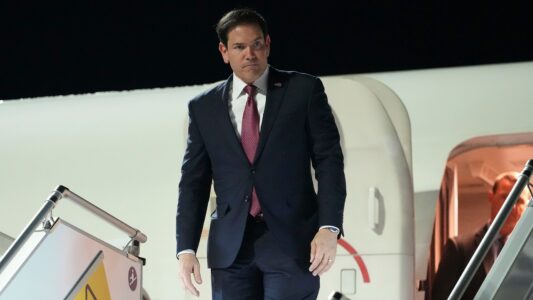

US Secretary of State Marco Rubio on Sunday said diplomatic efforts with Iran had made little progress, describing Tehran’s demands as “unacceptable”, “outrageous” and “ridiculous”. Speaking to reporters after arriving in France for a G7 foreign ministers’ meeting, Rubio said Washington remained open to a diplomatic solution but suggested that negotiations were currently going nowhere.
“Right now it hasn’t been very productive because the Iranian demands are simply not just unacceptable, but in some cases outrageous and ridiculous and really not realistic,” Rubio said.
He added that the US would explore a diplomatic solution if an opportunity emerged, while acknowledging that such efforts were not always possible.
Rubio also defended President Donald Trump’s approach to Iran, arguing that previous administrations had failed to confront the longstanding threat posed by Tehran.
“The president took on something that other presidents have failed to do,” Rubio said, adding that confronting difficult security challenges was sometimes unpopular but necessary.
Trump Says Fresh Military Strikes On Iran ‘Highly Unlikely’
Rubio’s remarks came as Trump expressed confidence that the US would not need to resume military action against Iran, provided negotiations over Tehran’s nuclear program and the reopening of the Strait of Hormuz made progress.
In an interview with CNN, Trump repeated five times that fresh military action was “highly unlikely”, while warning that American forces remained prepared to launch further strikes if an agreement could not be reached. “It depends on whether or not they sign a very strong agreement,” Trump said. “The answer is highly unlikely it’s going to be necessary.”
However, the US President warned that Washington could still launch another military campaign if required. “We’re ready for it. I’ve got three aircraft carriers here. The other one just arrived. We have three. They’re fully locked and loaded,” he told CNN.
Trump also revealed that the US had identified infrastructure targets inside Iran, including power plants and bridges, that could be struck if hostilities resumed.
“We have 38 bridges in our site that we can knock down in literally one hour. They’ll all be down,” he said.
Despite the warning, Trump said he would prefer not to destroy Iranian infrastructure, arguing that rebuilding it could take years.
Iran Conflict Remains At A Stalemate
The comments come eight months after the war began, with the conflict having reached a stalemate. Military activity has been limited, while diplomatic efforts have yet to produce significant progress.
Iranian attacks on oil tankers passing through the Strait of Hormuz have continued. The US, Iran and Qatar, which has mediated negotiations, have not publicly disclosed the current state of the talks.
Meanwhile, Iranian hardliners have pointed to the Republican Party’s defeat in the recent US midterm elections, where opposition to the war was a factor, as evidence that Trump’s political position has weakened.
Tehran continues to maintain that its nuclear program is intended for civilian energy purposes. Iran is also facing mounting economic pressure from US sanctions restricting crude oil sales and billions of dollars in assets frozen in foreign banks.