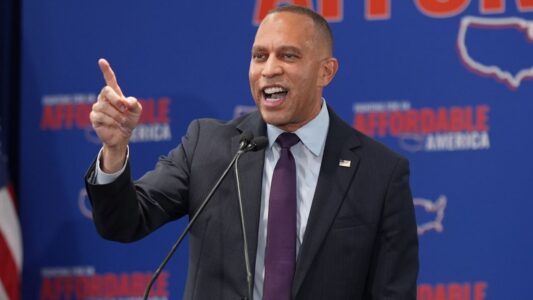

Six years ago, Hakeem Jeffries stood before the US Senate as one of the House Democrats appointed to prosecute the first impeachment case against Donald Trump. Now, the New York Democrat is on course to become the first Black Speaker of the US House of Representatives, following his party’s victory in the 2026 midterm elections.
Democrats have regained control of the House, ending the Republican majority that began in 2023. Their gains in traditionally Republican states, including Texas, Ohio, Kansas and South Carolina, marked a significant setback for Trump and his party.
Jeffries, 56, is expected to take over the speakership when the new Congress convenes in January, subject to a vote by the full House. The position is one of the most powerful in the US political system and places its holder second in the presidential line of succession.
His elevation would also mark a historic milestone. No Black lawmaker has previously held the position, which is the only leadership post in Congress mandated by the US Constitution.
Jeffries was greeted with chants of “Speaker! Speaker!” at the Democrats’ election night gathering in Washington. “This is not a partisan moment. This is a patriotic one,” he told supporters.
He said Democrats understood that the election was a change election and that “the American people are crying out for transformational change”. “We hear you,” he said. “We’re going to work hard to deliver on the dramatic change that you deserve.”
But his expected rise to the speakership comes with significant challenges. He will have to hold together a diverse Democratic majority, manage divisions within the party over Israel and confront the Trump administration during the president’s final two years in office.
The Rise of Hakeem Jeffries
Born in Brooklyn, New York, Jeffries represents the state’s Eighth Congressional District, which includes parts of Brooklyn and has a strong civil rights history. Parts of the district were once represented by Shirley Chisholm, the first Black woman elected to the US Congress.
Jeffries began his political career in the New York State Assembly, where he served from 2007 to 2012. During that period, he introduced more than 70 bills and worked on issues including policing and criminal justice.
One of his legislative achievements was a 2010 law restricting police from maintaining databases of people who had been stopped and searched but not arrested.
He entered Congress in 2013 and developed a reputation as a lawmaker willing to work across party lines.
He was among the sponsors of the bipartisan First Step Act, a criminal justice reform bill signed into law by Trump in December 2018. The legislation eased certain mandatory minimum sentences, expanded opportunities for early release and ended some prison practices, including shackling women during childbirth.
In November 2022, House Democrats unanimously elected Jeffries to succeed Nancy Pelosi as their leader. He became the first African American to lead a party caucus in either chamber of Congress.
His rise was widely attributed to his ability to build consensus and maintain unity among Democrats with differing political views.
The Trump Impeachment Trial that Brought Him National Attention
Jeffries came to wider national prominence during Trump’s first impeachment trial in 2020. He was one of seven House Democrats appointed to present the case against the then-president before the Senate.
During the proceedings, Jeffries ended a speech with a reference to rapper The Notorious B.I.G.: “And if you don’t know, now you know.” The line became one of the memorable moments of the trial.
His profile within the party grew further in January 2023, when Republicans struggled to elect a Speaker at the beginning of the 118th Congress.
Jeffries emerged as the Democratic nominee and received 212 votes, all from his own party, across multiple rounds of voting. Republican Kevin McCarthy, meanwhile, needed 15 ballots before securing the position.
When McCarthy was eventually elected, Jeffries handed him the Speaker’s gavel after delivering a speech that became known as the “ABCs of Democracy”.
A Historic First
If elected Speaker, Jeffries would become the first Black person to hold the office in more than 150 years of congressional history.
His elevation would carry particular significance at a time when several gains made during the civil rights movement are facing renewed challenges, including over voting rights and congressional redistricting.
The Brooklyn-born Democrat would also become the highest-ranking Black elected official in the country.