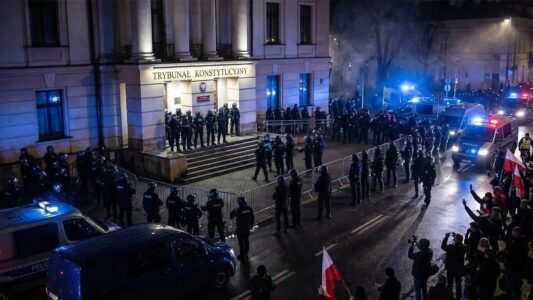

Poland’s Constitutional Court has been plunged into turmoil after a judge barred from hearing cases ordered the suspension of its president and deputy, prompting accusations of a coup and protests outside the building.
Anna Korwin-Piotrowska announced on Friday that she was taking charge of the court after ordering its president, Bogdan Święczkowski, and his deputy to be suspended for a month. Święczkowski rejected her authority and accused those involved of staging a “coup d’état”. His deputy was turned away at the court’s entrance.
The confrontation marks a fresh escalation in Prime Minister Donald Tusk’s efforts to reverse judicial reforms introduced by the former nationalist Law and Justice (PiS) government.
During its eight years in power, PiS appointed judges to the Constitutional Tribunal, including Święczkowski and his deputy. The court became a central point of conflict between Poland and the European Union over judicial independence and the rule of law.
Outside the court, protesters clashed with police. Officers said objects had been thrown at them and three people were detained after climbing over the building’s fence. Police said they had deployed to maintain security following warnings of threats against judges and staff, but had not entered the building.
🇵🇱 Thousands of Poles are now gathered in front of the Constitutional Tribunal building in Warsaw, which has been occupied by police sent by Donald Tusk’s government. Opposition figures are describing Tusk’s actions as an attempted coup. https://t.co/NcqYhJeeCl
— Europa.com (@europa) October 30, 2026
PiS leader Jarosław Kaczyński joined the protest and tried to enter the court. He accused Tusk of staging a “coup” against the institution and turning Poland into a “police state”, while calling for intervention by the president.
President Karol Nawrocki, an ally of PiS and political rival of Tusk, cut short an official visit to Senegal. “At a moment like this, the president must be in Poland,” he wrote on X.
Tusk defended his government’s approach, saying the restoration of the rule of law was a duty. “After years of PiS lawlessness, it’s a difficult, sometimes painful process that requires decisive action. There is no other way,” he wrote on X.
The Constitutional Tribunal has the power to strike down legislation. Under the previous PiS government, it helped impose an almost total ban on abortion and challenged the supremacy of EU law.
In December, the EU’s top court ruled that the tribunal did not meet European standards of judicial independence.
A Decade-Long Dispute Over Judicial Independence
The latest confrontation is rooted in a dispute that began in 2015, when PiS appointed judges to the Constitutional Tribunal in a process later considered irregular by the European Court of Human Rights in 2021.
The dispute contributed to a wider confrontation between Poland and Brussels over judicial reforms, with the EU freezing funds over concerns about the rule of law.
🚨 CHAOS IN POLAND: Court chief cuts through gate chains as president rushes back to Warsaw!In extraordinary scenes outside Poland’s Constitutional Tribunal, its disputed chief, Bogdan Święczkowski, attempted to enter the building with opposition lawmakers. A locksmith cut through the gate’s metal fastening, but police still blocked access to the building.Meanwhile, President Karol Nawrocki has landed in Warsaw after turning his plane around mid-flight to Senegal as the constitutional crisis escalates.Opposition leaders accuse PM Donald Tusk’s government of attempting a “coup.” The government says it is restoring the rule of law.Poland’s two political camps are now openly clashing over control of one of the country’s highest courts.
— NEXTA (@nexta_tv) October 30, 2026
Since returning to power in December 2023, Tusk’s government has challenged the legitimacy of parts of the tribunal and stopped publishing some of its rulings.
The dispute has intensified over appointments to the court. Nawrocki refused to swear in five judges elected by Tusk’s parliamentary majority. They subsequently took their oaths in parliament, but Święczkowski prevented them from hearing cases.
Justice Minister Waldemar Żurek blamed the crisis on the tribunal’s president, accusing him of turning the institution into his “private fiefdom” and preventing newly elected judges from carrying out their duties. “And now the judges have spoken,” Żurek told POLITICO.
Żurek, who also serves as prosecutor general, said he had submitted five requests to lift the immunity of Święczkowski and his deputy. The requests were supported by 50 volumes of case files.
He defended Korwin-Piotrowska’s decision, saying she was a legally appointed judge and insisting that the government had no involvement in her move.
Why Both Sides Are Accusing Each Other of a Coup
The dispute reflects two competing claims over the legitimacy of the Constitutional Tribunal. Święczkowski filed a complaint with the prosecutor’s office in January 2025, accusing Tusk and senior government officials of attempting a systemic coup by undermining the Constitutional Tribunal, the Supreme Court and the National Council of the Judiciary.
Polish President Nawrocki cut short his flight to Senegal on Friday and returned to Poland after police entered the Constitutional Tribunal and its president, Bogdan Swieczkowski, was suspended.Police cited violent incidents outside the court, including objects thrown at officers.The crisis follows a prolonged political dispute over judicial appointments that has effectively paralyzed the tribunal. https://t.co/UkI7bBejFs
— Clash Report (@clashreport) October 30, 2026
PiS argues that the latest developments are part of that effort to weaken the country’s judicial institutions.
Tusk’s government, meanwhile, says the tribunal was captured by PiS and is being used to block judges elected by the current parliamentary majority.
Korwin-Piotrowska had previously said on public television that, in her view, Święczkowski was breaking the law by preventing the newly elected judges from hearing cases.
There has been no military intervention, the government elected in 2023 remains in office and the president continues to exercise his functions. The crisis is centred on competing claims to authority within the Constitutional Tribunal.
The legality of the order suspending Święczkowski is likely to become a central issue, with no mutually accepted authority currently able to resolve the dispute.
What Happens Next?
The confrontation could leave the court with two rival claims to leadership. Święczkowski has rejected the suspension order, while Korwin-Piotrowska says she is taking charge. Any decisions issued by the tribunal could therefore face challenges over its authority.
Nawrocki could also respond by addressing the country, convening the National Security Council or taking further action against government legislation.
The protests outside the court could grow in the coming days, while the European Commission’s response will be closely watched given its earlier confrontation with the PiS government over judicial reforms.
The crisis also comes at a difficult political moment for Tusk. His coalition holds a narrow majority in parliament, while Nawrocki has blocked or vetoed several government initiatives, including measures relating to abortion and appointments.
With parliamentary elections due in 2027, the dispute over control of the Constitutional Tribunal is becoming a major test of the balance of power between the government, the presidency and the judiciary.